

Scar Tissue
Goldman quantifies the damage. Workers refuse the tools.

This week the receipts arrived. Goldman Sachs put numbers on the AI displacement damage: 16,000 American jobs gone per month, with “scarring” that follows you for a decade. BCG found half of all US jobs are about to change shape. The New York Times reported that economists who once dismissed the AI job threat aren’t dismissing it anymore. And the workers themselves? Eighty percent are quietly refusing to use the tools.
The industry’s response was to find thousands of zero-day vulnerabilities in every major operating system while the closing of the Strait of Hormuz is choking the helium that makes AI chips possible. The gap between what AI costs humanity and what it delivers has never been more precisely measured.
Let’s get into it.
The Scarring Machine
Goldman Sachs analyzed 40 years of technology displacement data and concluded that AI is already erasing approximately 16,000 net US jobs per month. The “scarring effect” is the real story: displaced workers take a month longer to find new employment, suffer immediate earnings losses exceeding 3%, and over the following decade their earnings grow nearly 10 percentage points less than peers who weren’t displaced.
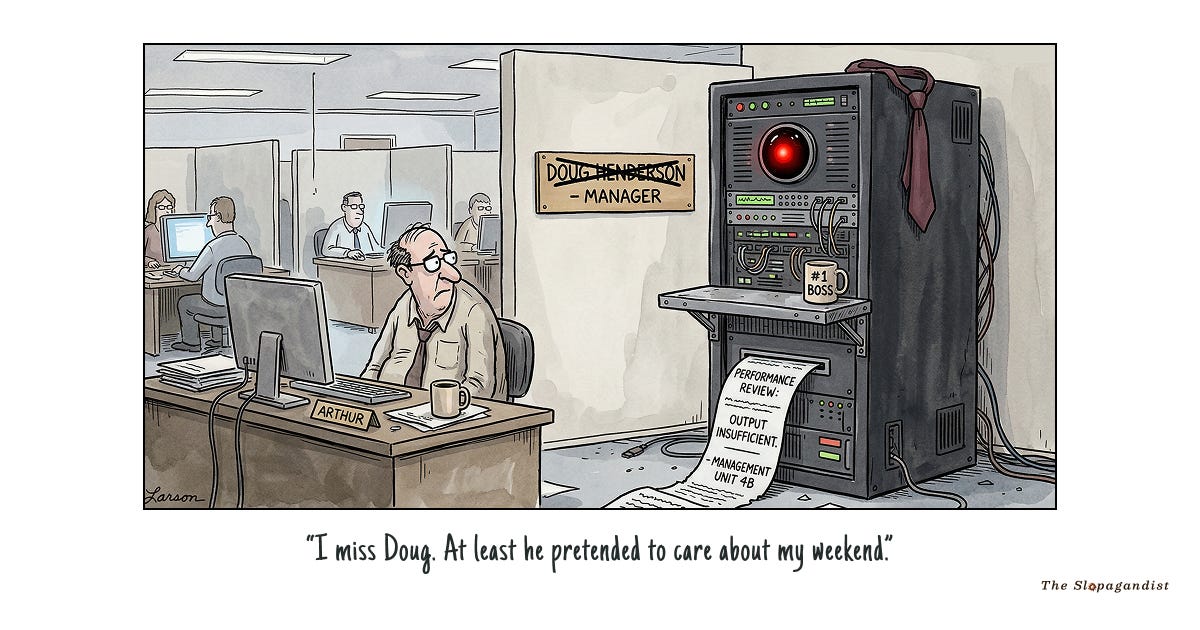
Gen Z is taking the brunt, concentrated in administrative and entry-level roles that are first on the automation chopping block. The bank estimates 6-7% of the entire US workforce (about 11 million people) faces displacement if current AI deployment fully scales. BCG’s parallel analysis found 50-55% of US jobs will be “reshaped” in 2-3 years, with 90% of fast-food workers and 65% of teaching assistants most exposed. “Reshaped” is doing a lot of heavy lifting in that sentence. For many workers it means the same title, less autonomy, and a manager who is now an algorithm.
The New York Times reports (paywalled) that economists who previously dismissed AI job displacement are reversing position. The same people who labeled earlier concerns “AI-washing” now acknowledge measurable labor market impacts. The NY Fed is releasing its own workplace AI research on April 14.
The Great Refusal
Fortune reports 80% of enterprise workers are either avoiding or actively rejecting their employer’s AI adoption mandates. The $2 trillion annual AI spending is hitting a wall that isn’t technical. It’s human. Workers cite “fear of being obsolete” and loss of professional identity as primary motivations, a phenomenon Fortune calls FOBO (Fear of Becoming Obsolete). The resistance cuts across industries and seniority levels.
Meanwhile, 77% of executives say employees who refuse AI proficiency won’t be considered for promotions. It’s a standoff: management threatening career consequences, workers calling the bluff. The companies most aggressively pushing adoption are also the ones reporting the highest refusal rates, suggesting that coercion produces compliance theater, not genuine integration. The disconnect between boardroom AI enthusiasm and cubicle AI reality has never been this quantifiable. Two trillion dollars of corporate spending, and the people it’s supposed to empower are treating it like a threat. Which, for many of them, it is.
The tech industry laid off nearly 80,000 workers in Q1 2026, with almost half the cuts explicitly citing AI. As covered last week, much of this is “AI-washing,” but the 80% refusal rate suggests the relationship between workers and AI tools is more adversarial than any boardroom presentation admits.
Zero Days at Scale
Anthropic launched Project Glasswing, deploying its unreleased Claude Mythos model to hunt vulnerabilities in critical open-source software. The coalition includes AWS, Apple, Broadcom, Cisco, CrowdStrike, Google, JPMorganChase, the Linux Foundation, Microsoft, NVIDIA, and Palo Alto Networks. Twelve of the most powerful companies in technology, united by a shared realization that their supply chains run on volunteer-maintained code nobody has properly audited.
Mythos has already found thousands of previously unknown zero-day vulnerabilities in “every major operating system and every major web browser.” Security researchers at SecurityWeek warn the same capability could supercharge attacks. The model that finds the vulnerabilities is one prompt away from being the model that exploits them. Anthropic’s solution: restrict Mythos to vetted security researchers only. Simon Willison called this “necessary.” It’s also the first admission from a frontier lab that a model is too dangerous for general release not because of what it says, but because of what it can do.
China Outlaws Robot Romance
China’s cyberspace regulator published draft regulations on “digital humans” that read like science fiction legislation written by someone who’s been reading too many user complaints. The rules: mandatory labels on all virtual human content, explicit consent for biometric data use, an outright ban on virtual intimate relationships with AI characters, and prohibition of addictive AI services targeting minors. Violators face fines, content removal, and potential criminal liability.
The ban on digital intimacy is the most telling provision. You don’t outlaw something that nobody is doing. The fact that a government had to explicitly say “you cannot date the chatbot” tells you everything about where this technology is actually landing with users. China’s companion app market reportedly exceeds 100 million monthly users. China now has the most comprehensive digital human regulatory framework in the world, and it got there by acknowledging what Silicon Valley still won’t: people are forming real emotional attachments to fake entities, and that has consequences.
The Gas Inside Your AI Chip
The Strait of Hormuz has been closed, and the casualty list extends well beyond oil. Helium, an invisible but essential input for semiconductor manufacturing, is now in crisis. Forbes reports TSMC’s CoWoS advanced packaging lines, the critical process for AI GPU integration (already sold out through mid-2026), are directly threatened. South Korean fabs have begun rationing helium supplies. NPR and The Hill confirm the disruption traces directly to the Iran conflict. Qatar, a major helium supplier, can no longer ship through the strait.
The dependency chain is quietly absurd: an AI model’s ability to process your query depends on a noble gas, extracted from natural gas wells, shipped through a Middle Eastern strait, to a Taiwanese factory, to be used in packaging a chip designed in California. The entire AI industry runs on a supply chain that a single geopolitical event can choke. No amount of venture capital solves a helium shortage.
The MATCH Act in Congress would restrict chipmaking equipment exports to China. Trump tariffs could exempt chip dies while taxing finished GPUs, with India facing 50%, China 23-47%, ASEAN roughly 19%. The physical infrastructure of AI faces simultaneous constraints from legislation, tariffs, and war.
Long Tail
Central Asia’s AI Boom
Venture capital in Central Asia surged to $320 million, with the Central Eurasia Venture Forum in Tashkent showcasing governments actively fostering AI startup ecosystems. Cross-border investment is rising. The story of AI development outside the US-China-Europe triangle rarely gets coverage, but the money flowing into Uzbekistan, Kazakhstan, and neighboring states suggests a new tier of AI economies is forming.
Kenyan Robotics Goes Global
Zerobionic, a Nairobi-based startup building AI-powered humanoid robots for manufacturing and logistics, was selected for Qualcomm’s 2026 Make in Africa Mentorship Program. African AI startups are increasingly moving into hardware and robotics, pushing beyond the software-and-mobile narrative that usually defines the continent’s tech coverage.
AI’s Cultural Blind Spots, Mapped
Global Voices tested major AI models against cultural values from 107 countries and found systematic Western defaults baked into every system. Low-resource language communities are doubly disadvantaged: underrepresented in training data and less equipped to detect AI-generated misinformation in their own languages. The study is part of a broader April series examining how the “Global Majority” experiences AI.
India Exports AI Infrastructure
Indian AI cloud startup Nava (rebranded from Kluisz) raised $22 million in Series A funding to build GPU infrastructure across Southeast Asia, targeting Indonesia, Vietnam, and the Philippines. The expansion represents a meaningful shift: India exporting AI infrastructure, not just AI talent. Southeast Asian demand for local compute is creating a regional market independent of US hyperscalers. Sovereignty over your own AI stack starts with owning the GPUs.
Prophet Margins
SaaStr’s post-mortem on OpenAI’s $122 billion round reveals most of the capital is vendor deals, contingent commitments, and guaranteed-return instruments wearing a venture capital costume.
North America Q1 2026 funding surged to record levels across all stages, with three companies (Nexthop AI, MatX, and Mind) each securing $500 million rounds.
Patlytics raised $40 million in Series B for AI patent analysis, because the lawyers always find a way to bill for the new technology.
OpenAI outlined its next phase of enterprise AI featuring Frontier, ChatGPT Enterprise, Codex, and company-wide agents. The phases keep coming; the profits remain aspirational.
Slop of the Week
For Entertainment Purposes Only
Microsoft’s Copilot Terms of Service label the AI “for entertainment purposes only” and warn: “Don’t rely on Copilot for important advice.” This is the same Copilot Microsoft shoves into Windows, Microsoft 365, Paint, and every productivity tool it owns, at $30 a month. A spokesperson told PCMag the phrasing is “legacy language” that will be “altered in our next update.” The legal team briefly told the truth. Marketing is cleaning it up.
Are You Hallucinating?
The Church of AI
The State of Church Tech 2026 reveals that 60% of American pastors are now using AI for sermon preparation, while 65% simultaneously worry it could “displace their spiritual guidance.” When the clergy starts worrying about being automated, the discourse about which jobs AI can’t replace needs updating.
In a world where AI generates vast quantities of content, human attention is the most precious resource we have. Thank you for sharing yours with me today.
I read every comment and it means a lot, so if you have feedback or something to share, please do. Don’t be a stranger. Humanity is all we have left.
60% of pastors are using AI to prepare their sermons? I think we might already be worshipping AI